
Whole body vibration is often discussed in practical clinical terms: balance, fall risk, muscle activation, mobility, and bone loading. Those are the outcomes healthcare providers care about. But beneath those functional effects is a more fundamental question: how does the body convert mechanical stimulation into biological response?
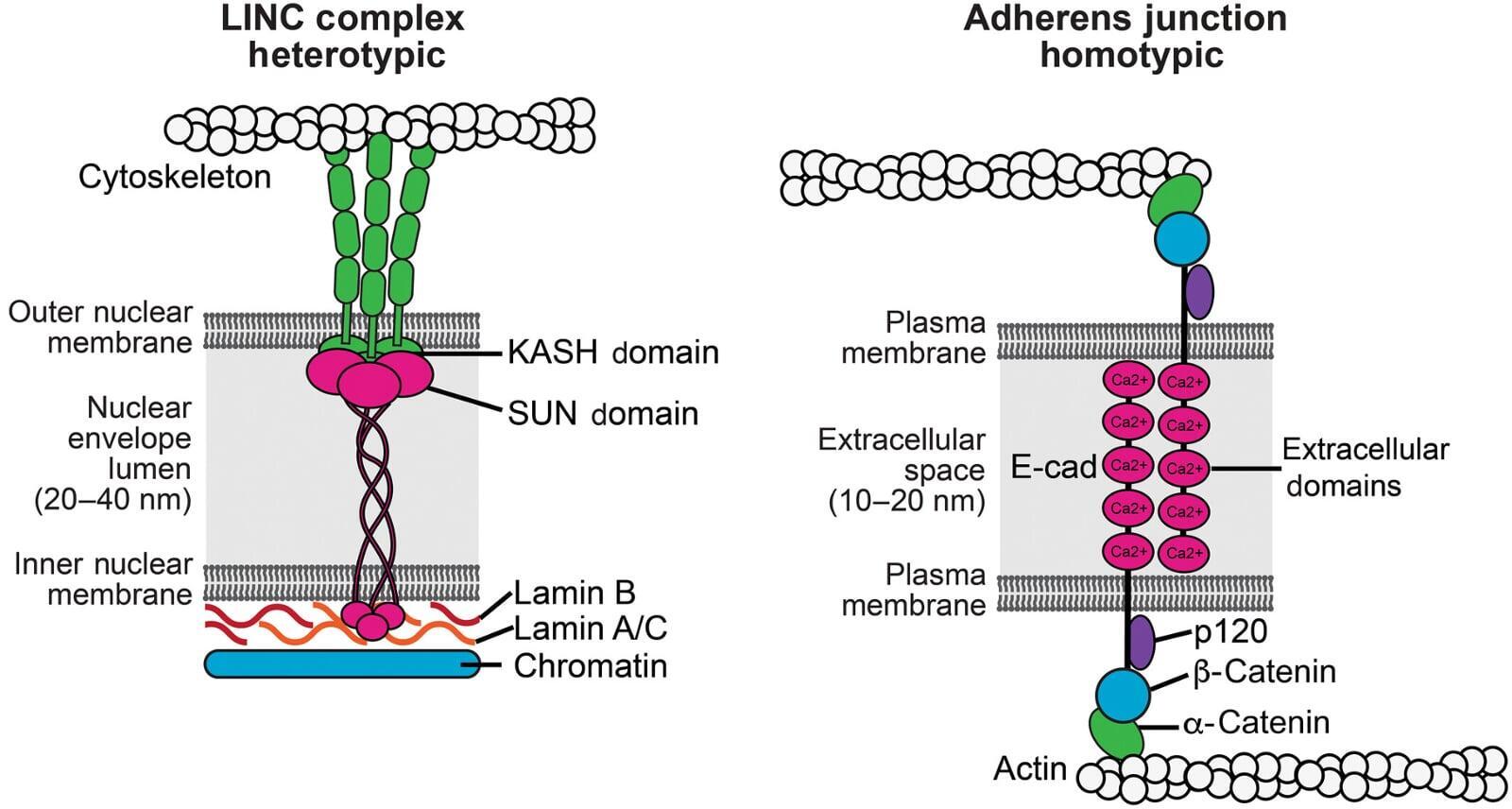
A review by Megan C. King in FEBS Letters helps answer that question at the cellular level. The article, Dynamic regulation of LINC complex composition and function across tissues and contexts, focuses on the Linker of Nucleoskeleton and Cytoskeleton, or LINC complex. This structure spans the nuclear envelope and physically connects the cytoskeleton outside the nucleus to the nuclear lamina and chromatin inside the nucleus. In simpler terms, the LINC complex helps cells transmit mechanical information from the outside of the cell all the way to the genome.
That matters when thinking about whole body vibration. The article does not study vibration therapy directly. Instead, it explains a biological framework that helps clinicians understand why mechanical inputs, including vibration, resistance exercise, loading, stretching, compression, and shear forces, may influence tissue adaptation. If mechanical signals can affect the cytoskeleton, nuclear structure, gene expression, and protein turnover, then mechanical therapies should not be viewed only as external forces. They are biological signals.
Why the LINC Complex Matters
Cells are not passive containers. They constantly sense their physical environment. Mechanical inputs from movement, loading, muscle contraction, posture, and tissue deformation are transmitted through the extracellular matrix, cell membrane, cytoskeleton, and eventually to the nucleus.
The LINC complex is one of the key structures that allows that transmission to occur. It is formed largely through SUN proteins in the inner nuclear membrane and KASH-domain proteins, including nesprins, in the outer nuclear membrane. Together, these proteins connect the cytoskeleton to nuclear lamins and chromatin.
King’s review emphasizes that there is not one fixed LINC complex. Instead, LINC complex composition varies by tissue, protein isoform, splice variation, mechanical environment, and cellular context. The mechanical environment can remodel LINC complex components, suggesting a feedback system in which cells adapt their nuclear-cytoskeletal linkage based on the forces they experience.
Mechanical Signals Reach the Nucleus
For healthcare providers, the most important concept is nuclear mechanotransduction. Mechanical force does not stop at the muscle fiber, tendon, bone, or fascia. At the cellular level, force can be transmitted to the nucleus, where it may influence nuclear shape, chromatin organization, transcription factor localization, gene expression, and cellular adaptation.
This helps explain why mechanical therapies can have effects that extend beyond immediate muscle contraction. Resistance training, balance work, gait training, and vibration-based stimulation may all provide mechanical cues that cells interpret and respond to. The response depends on dose, tissue type, patient condition, and the cell’s existing mechanical environment.
Relevance to Muscle and Bone Health
The LINC complex is especially relevant to musculoskeletal tissues because muscle and bone are mechanically responsive. Skeletal muscle adapts to mechanical load by altering protein synthesis, architecture, and force-generating capacity. Nuclear mechanotransduction is now being investigated as part of that adaptive response.
This is where whole body vibration becomes clinically interesting. WBV delivers repeated mechanical oscillations through the body, usually through the feet in standing or seated positions. Depending on the platform, frequency, amplitude, patient position, and duration, vibration can stimulate muscle activation, postural responses, proprioceptive input, and skeletal loading.
Clinical studies and systematic reviews suggest that WBV may improve selected outcomes related to muscle strength, function, gait, balance, and physical performance in older adults, although protocols and results vary. Evidence for bone mineral density is mixed, with some reviews reporting potential regional benefits and others finding limited or inconsistent effects.
This is an important distinction. The cellular science supports the plausibility of mechanical stimulation as a biological signal. It does not mean every vibration protocol produces the same clinical result. Clinicians still need to match the intervention to the patient.
From Modality to Mechanobiology
Whole body vibration should not be framed simply as a passive modality. A better clinical framing is mechanobiologic stimulation. The patient is exposed to controlled mechanical input, and the body responds through muscle contraction, sensory feedback, postural adjustment, tissue loading, and cellular mechanotransduction.
For older adults, deconditioned patients, patients with balance deficits, and those who cannot initially tolerate higher-load exercise, WBV may provide a practical way to introduce mechanical stimulation. It can be combined with standing, mini-squats, heel raises, balance positions, seated foot placement, or upper-extremity contact positions, depending on the platform and clinical goal.
The King review adds depth to this discussion because it reminds clinicians that mechanical load is not only a gross orthopedic concept. It is also a cellular language. Structures such as the LINC complex help translate force into nuclear response, and the body’s response to mechanical therapy depends partly on how cells sense and process those signals.
Takeaway for Healthcare Providers
Whole body vibration is best understood as a controlled mechanical stimulus, not simply as a fitness device or passive treatment. The review by King does not test WBV directly, but it helps explain why mechanical stimulation can matter biologically. Through mechanotransduction pathways that include the cytoskeleton, nuclear envelope, LINC complex, lamins, and chromatin, cells can convert physical force into biological activity.
For clinical practice, this supports a thoughtful use of whole body vibration as part of a broader musculoskeletal and functional care plan. WBV may be useful when the goal is to introduce safe mechanical loading, stimulate reflexive muscle activity, support balance training, improve movement confidence, or provide an entry point for patients who are not ready for heavier resistance exercise.
Reference
King MC. Dynamic regulation of LINC complex composition and function across tissues and contexts. FEBS Lett.2023;597(22):2823-2832. doi:10.1002/1873-3468.14757.
To learn more about whole body vibrationemail usor call 860-707-420